
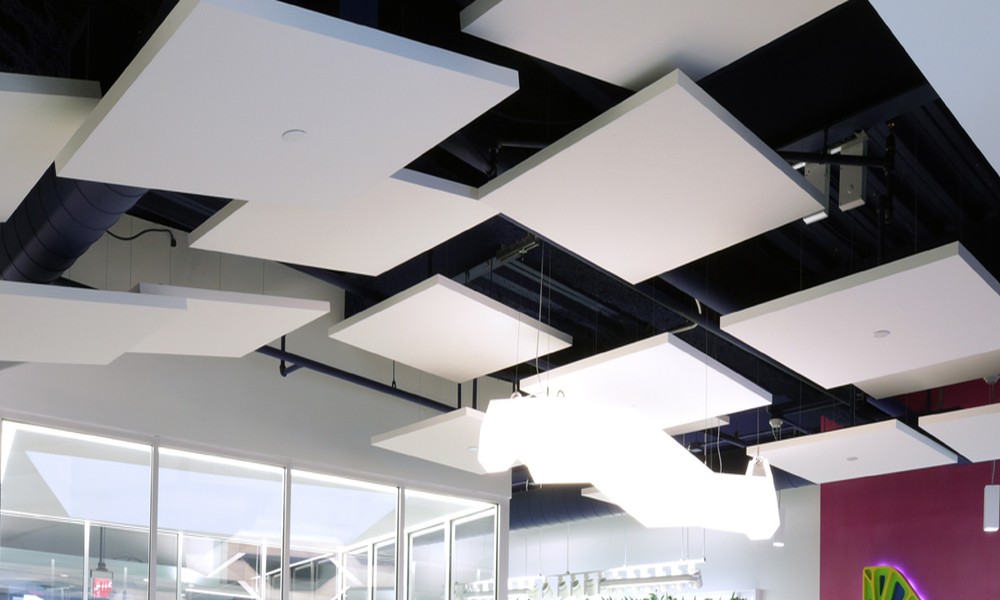
When people start looking into improving room acoustics, one of the first solutions that comes up is an acoustic ceiling panel.
It makes sense. The ceiling is a large surface area, often left untreated, and it sits right above where most sound activity happens.
But here’s where expectations sometimes get a bit off.
Acoustic panels for ceilings can make a noticeable difference, but they don’t solve every noise problem. Understanding what they can and can’t do helps set more realistic expectations and leads to better overall results.
Let’s walk through it in a practical, no-nonsense way.
What an acoustic ceiling panel actually does.
At its core, an acoustic ceiling panel is designed to absorb sound, not block it.
That distinction matters.
Instead of stopping sound from passing through walls or ceilings, it works by:
- Reducing how much sound reflects within a room
- Softening echoes and reverberation
- Improving clarity of speech and overall sound quality
So if a space feels “echoey” or too lively, ceiling panels help calm things down.
You’ll often notice:
- Conversations becoming clearer
- Less “ring” or bounce in the room
- A more controlled and comfortable sound environment
That’s the main job, and they do it quite well.
Where they make the biggest difference.
Ceiling panels tend to work best in spaces where sound reflects a lot from above.
Think of rooms like:
- Offices with hard ceilings
- Meeting rooms with minimal soft finishes
- Classrooms or training spaces
- Restaurants or cafés with open layouts
In these environments, sound doesn’t just travel sideways-it also bounces up and down.
Installing acoustic panels helps reduce that vertical reflection, which is often a major contributor to echo.
And because the ceiling covers a wide area, treating it can have a noticeable impact without taking up wall or floor space.
They help with echo, but not soundproofing.
This is probably the biggest misconception.
An acoustic ceiling panel improves how sound behaves inside a room.
It does not:
- Stop noise from entering or leaving the room
- Block loud external sounds
- Prevent sound transmission through walls or floors
So if the goal is to stop noise from the next room or from outside traffic, ceiling panels alone won’t do the job.
They’re about sound quality, not sound isolation.
They don’t fully eliminate noise-just control it.
Another expectation to manage is total noise reduction.
Ceiling panels won’t make a room silent.
What they do instead is:
- Reduce the intensity of reflected sound
- Shorten how long sound lingers
- Make noise feel less overwhelming
So the space still has sound-it just feels more balanced.
In practical terms, that means:
- Conversations are easier to follow
- Background noise feels less intrusive
- The room feels calmer overall
But you’ll still hear activity happening around you.
Placement and coverage matter more than people think.
Not all ceiling panel setups perform the same way.
It’s not just about installing them-it’s about how much coverage there is and where they’re placed.
For example:
- Partial coverage may reduce echo but not fully control it
- Panels placed too far apart may leave reflective gaps
- Certain zones may need more treatment than others
So while an acoustic ceiling panel is effective, its performance depends heavily on how well it’s planned.
It’s less about having panels, and more about having enough of them in the right places.
They work best as part of a larger acoustic setup.
If a space has more complex noise issues, ceiling panels are usually just one part of the solution.
They’re often combined with:
- Wall-mounted acoustic panels
- Soft furnishings like carpets or curtains
- Partitioning to break up sound paths
This layered approach helps manage sound more completely.
On their own, acoustic ceiling panels handle vertical reflections well. But for full acoustic comfort, other surfaces usually need attention too.
They don’t fix layout-related noise problems.
Sometimes the issue isn’t just acoustics-it’s how the space is used.
For example:
- Workstations placed too close together
- Meeting areas located in open zones
- High-traffic paths running through quiet areas
In these cases, even a good ceiling panel setup can only do so much.
Sound will still travel if the layout encourages it.
So while ceiling panels improve the environment, they don’t replace the need for thoughtful space planning.
Final Thoughts
An acoustic ceiling panel is a practical and effective way to improve how a room sounds, but it’s not a catch-all solution.
It works best for:
- Reducing echo and reverberation
- Improving speech clarity
- Creating a more comfortable acoustic environment
But it won’t:
Once you understand that balance, it becomes easier to use ceiling panels the right way. Because in the end, good acoustics isn’t about removing sound completely, but about shaping it so the space feels natural, clear, and easy to use.